 Handcrafted in Aveyron, the historic home of the Laguiole knife
Built for daily use, collected for a lifetime. A traditional Laguiole knife is not merely a sharp edge; it is a piece of French bench craft that feels composed in the hand, looks impeccable on a linen-laid table and earns its place in your pocket day after day. This guide speaks to UK buyers who want both poetry and precision: we’ll decode the anatomy (bolsters, liners, forged spring, forged bee, shepherd’s cross), show how these choices change balance and longevity, and set out clear inspection and care routines so that the knife you choose today remains handsome and smooth years from now. Our curation is purposefully narrow: we only present Laguiole en Aubrac artisanal manufacture, because consistent finishing and traceable provenance matter when you buy once and intend to keep.
Browse the current range:
→ Laguiole Pocket Knives ·
→ Classic Single-Blade ·
→ Knife with Corkscrew ·
→ Brass-Bolster ·
→ Double-Plates ·
→ Damascus Steel ·
→ Special Editions ·
→ Limited & One-of-a-Kind
Why the 12 cm format is the reference you’ll actually carry
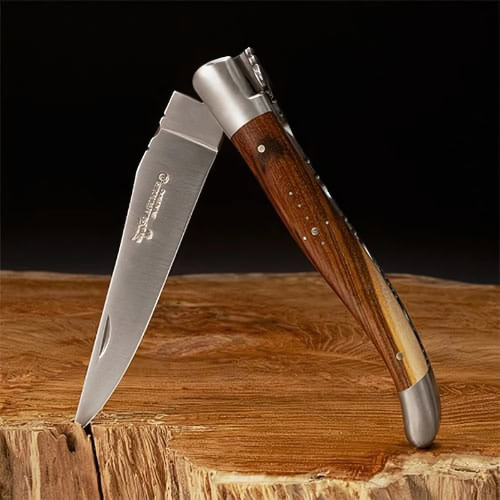
The Laguiole silhouette exists in several nominal sizes in the wider market, but the proportion that feels “inevitable” in the palm and discreet in a jacket pocket is the classic 12 cm closed (~22 cm open). It gives you a blade long enough for food, packaging and impromptu table service yet remains slim and composed in everyday British life. Our e-commerce selection, by design, focuses on this goldilocks dimension: it is the size most people end up carrying and the one collectors recognise instantly in profile. A good 12 cm Laguiole should feel balanced around the pivot, with a calm, even draw on opening and a confident, unhurried close; the handle should settle into the web of your thumb without hot spots, and the blade should track true along the liners without heel rub. If you are buying for a gift and want the safest recommendation in both feel and proportion, 12 cm is the “choose once, enjoy for decades” answer—handsome on the table, effortless in the pocket, and widely appreciated by first-time owners and connoisseurs alike.
Need more information? Visit the Category page of all Laguiole Pocket Knives.
Anatomy decoded : what every genuine Laguiole shares
A traditional Laguiole is a study in proportion and controlled tension. Begin at the blade: on classic 12 cm builds you’ll typically see stock in the ~2.7–3.0 mm range at the base of the blade, then a disciplined distal taper that carries stability through the spine while keeping the tip lively. The edge should present a clean, continuous bevel with a fine micro-bevel at the very apex; when you pass a soft thumbnail across it, it should “take” with confidence but not snag. Well-regulated grinds favour everyday food, cordage and packaging — the point pierces neatly, the mid-belly slices, and the heel has enough authority for controlled push-cuts.
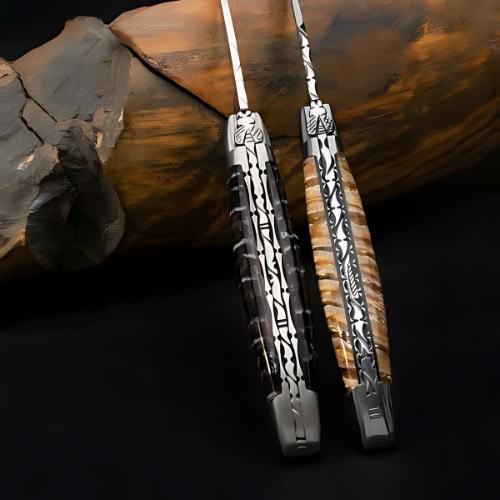
Behind the blade sits the true heart of a Laguiole: the backspring. On a good piece, the walk & talk reads as calm authority — an even, rising pull to open, a stable plateau at full deployment, then a composed, unhurried return. Many prestige models pair this with a forged spring and forged bee in one continuous piece. The benefit is not cosmetic alone: the forged assembly is stiffer and straighter over time, so the open stop feels certain, the blade path is more guided, and the guilloché has a seamless canvas. Traditional builds can feature a welded bee that is then dressed until the join disappears; done well, you will not find the transition by eye or fingernail.
Inside the frame, liners in stainless act as rails and take all pinning. You want linearity (no visible wandering line along the spine), symmetry (even daylight either side of the closed blade) and quietness under the thumb (no burrs, no raised edges). The scales — horn or wood — should be flush-pinned so you cannot detect where metal ends and material begins. Around the pivot, the head bolster sets the knife’s visual “weight”; if the chamfers mirror left and right and the polish lies flat with no waves, bench time has been spent where it counts. Many pieces carry the shepherd’s cross on one side: five pins, level with the surface, aligned like a fine watch index — more than a motif, it’s a finishing tell.
Finally, proportion. The classic envelope — 12 cm closed / ~22 cm open — is not a coincidence; it is the dimension at which the cutler’s geometry, the spring rate and the hand’s anatomy agree. In use, the centre of gravity should read close to the pivot, not nose-heavy; the blade should clear the liners without heel rub; and the closing note should be firm, civil and repeatable. When these little truths are present, the knife feels “inevitable” — the strongest compliment a Laguiole can earn.
Configurations that change feel — single bolster, double bolster, full-handle
Single-bolster knives keep a polished stainless frame at the pivot and let the handle material run to the tail. The result is lean and traditional, with a fraction less weight at the rear and a look that foregrounds the wood or horn. This is the archetype many purists love for its simplicity and everyday elegance. Double-bolster knives add a second frame at the tail, which protects the butt from café tables and pockets while creating the symmetrical “framed” silhouette most people picture when they think of a classic Laguiole; the extra mass reads as poise, not heft, when the spring is well regulated. Finally, full-handle (no-bolster) builds let material do the talking from head to tail, and on superior pieces they are paired with a forged spring and forged bee so the spine becomes a continuous canvas for hand guilloché. Choose single-bolster for lightness and purity, double-bolster for protection and dress-table formality, and full-handle for warmth in the hand and a deeper conversation with the cutler’s file.
Mechanics before ornament — how a good Laguiole should behave
Decoration is the final 10%; mechanics do the work. Cycle the knife slowly in hand. The pull on opening should be even from start to peak—no gritty spots, no hollow dip—then relax into a secure open position without wobble. Sight along the spine: the blade should run dead true between the liners, with consistent daylight either side when closed and no heel grind on entry. Close the blade and listen for a composed note: confident but never harsh. Run a fingertip along the spring and any spine work: the channels of the guilloché must feel crisp and even with no burrs, and the motif should mirror left and right if the liners are decorated. At the scale transitions, pins should be tactilely invisible and bolster seams tight enough that your nail cannot catch. If a knife looks elaborate but fails these simple checks, it is theatre without structure; the right piece will feel composed in seconds and stay composed for years with ordinary care.
One, two or three pieces — blade, corkscrew, awl
Retailers count functions when they say “1-piece”, “2-piece” or “3-piece”. A 1-piece is simply the blade—the sleekest pocket feel and the purest line. A 2-piece adds a corkscrew at the spine, a late-19th-century bistro refinement that changes the rhythm in hand slightly but proves invaluable when a bottle appears. A 3-piece adds a traditional awl/reamer (the historic trocar) which today serves well for leather and fieldcraft. If you entertain, picnic or gift to wine-lovers, a 2-piece pays for itself every week; if you want absolute slimness and symmetry, 1-piece will please you daily; if you enjoy heritage tools, the 3-piece is characterful without compromising elegance. Whatever the count, the action should remain even, centred and civil—ornament never excuses weak walk & talk.
Shop by intent:
→ Classic Single-Blade ·
→ Corkscrew Pocket Knives
Materials & finishes, tone, tactility and long-term grace
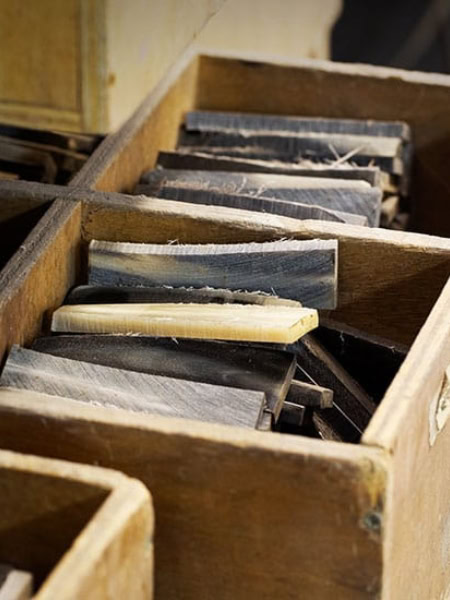
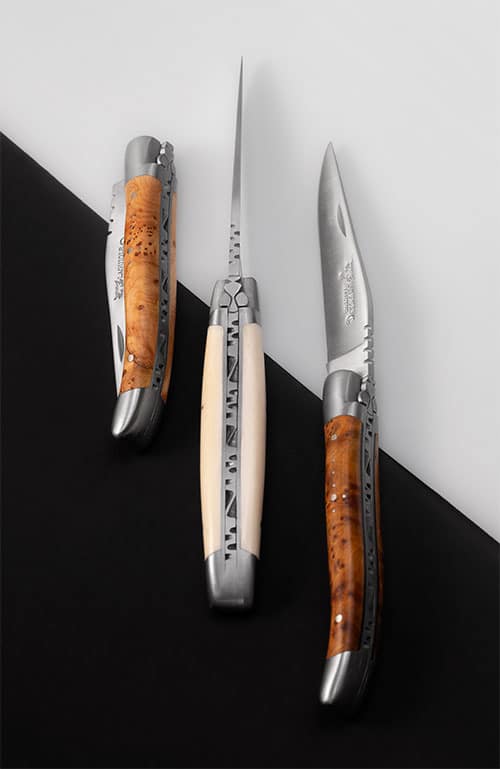
Handle material is the atmosphere you carry every day. Horn (blond or brown) delivers that unmistakable silk under the thumb and natural figure that shifts with light; it reads formal and “heritage”, especially against brass or bright stainless bolsters. Horn prefers a dry life, so store away from radiators and windowsills and give it space from rapid humidity swings. Among hardwoods, ebony is graphic and modern — a black-tie clarity that flatters mirror-polished metal and stainless Damascus. Walnut and pistachio balance warmth with restraint for everyday hospitality; olive and perfumed juniper bring Mediterranean conviviality — knots and streaks catch candlelight, and juniper adds a soft, resinous fragrance each time you open the blade.
If you crave theatre, choose burls and figured cuts. Their swirling end-grain can feel almost topographical, but that beauty is won from more complex structure: match expressive woods with a tail bolster or a Double-Plates frame when you want extra protection against knocks. On prestige builds, the spine and liners often receive hand file-work (guilloché); run a slow thumb along the channels — you should feel crisp valleys, not sanded blur. Where the liners are decorated, look for rhythm: the light should travel evenly down the frame, left and right in conversation. The bolsters themselves set the knife’s “temperature”: polished stainless is cool, crisp and fingerprint-tolerant in satin; brass is warm, develops a gentle patina and pairs beautifully with horn and olive, reading country-elegant on the table.
Blade finish influences both look and maintenance. A satin face hides casual scuffs and reads calm and utilitarian; mirror is ceremony — dramatic beside glass and porcelain, rewarding of careful wiping. If pattern speaks to you, stainless Damascus gives depth without aftercare anxiety: the layered lines animate the slim silhouette yet sharpen like a good stainless monosteel. Whatever you choose, judge the joins: pins must be flush, bolster seams invisible to the nail, scale edges level with liners. When those interfaces disappear, the material you’ve chosen — not the construction — becomes the story, and that is the essence of a refined Laguiole.
Damascus steel — pattern, performance and the easy way to live with it
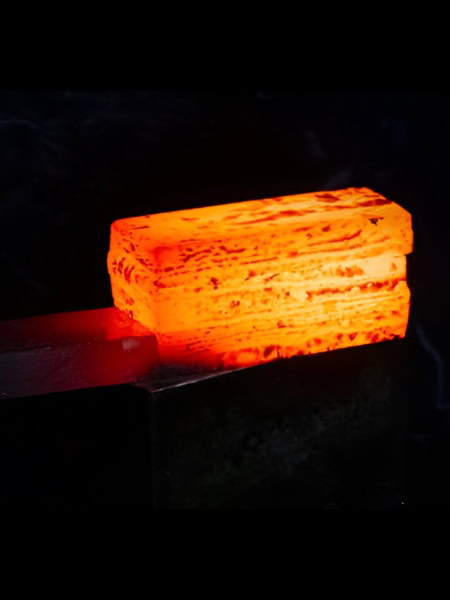
Damascus steel is a layered construction that, once etched, reveals flowing motifs—twist, raindrop and map-like currents—turning the Laguiole’s slim line into something quietly theatrical at the table. For everyday UK ownership, our recommendation is stainless Damascus: you get the visual depth and the fluent cutting feel without the aftercare anxiety of carbon laminae. Wipe and dry after food, avoid soaking, and sharpen as you would a good stainless monosteel; the edge responds well to light, regular maintenance and rewards a tidy finish on a fine strop. If you love ritual and patina, carbon Damascus will oblige with a living surface and a keen, ceramic-like bite, but it asks for vigilance: wipe immediately after acidic foods and give it a whisper of oil if the knife rests a while. If pattern steel speaks to your eye, begin your search here: Damascus Steel Pocket Knives.
Spine, plates & the forged bee — where craft becomes signature
The easiest way to read bench time is to read the back of the knife. On prestige builds, the forged bee and forged spring are one continuous canvas for the cutler’s file; the guilloché along the spring (and often along the plates) should feel crisp and even under a slow thumb, with no burrs to catch skin and no waviness in the pattern when you sight down the spine. A well-executed emblem blends into the spring with no visible step; the wings and relief feel sculptural rather than stamped. When plates are decorated, look for rhythm—motifs that echo the spine so light travels down the frame in a disciplined way. These details aren’t just ornament: a stiffer forged spring delivers a more certain open position, a truer close and a satisfying, composed note at the end of travel. If you want this level of dialogue between hand and tool, start with our curated Special Editions, Bees & Marquetry, then refine by material, finish and presentation.

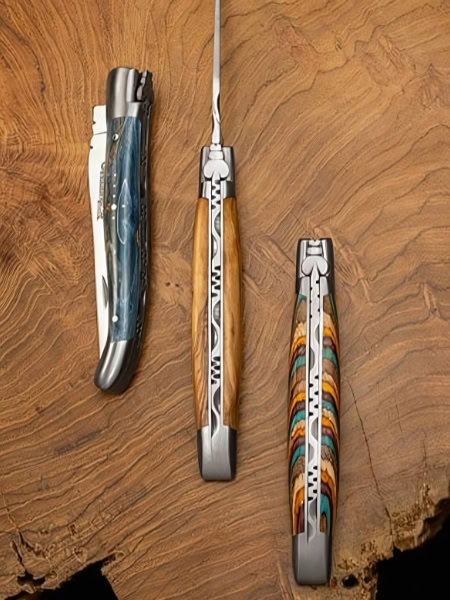
The 15-second inspection — and the collector’s micro-inspection
Sightline. Hold the closed knife at eye-level and sight down the spine: the blade should sit centred between the liners with even daylight either side; the spring should read as a single, straight line with no kinks. Open & seat. Deploy slowly: feel for a steady, rising pull and a stable plateau at full open; with a light behind the joint you should see no “daylight” — the blade foot must land squarely on the spring. Walk & talk. Close with intent: you want a confident, controlled note — never a violent slap, never a mushy drift. Nail test. Glide a fingertip along scales and bolsters; you should not find pins by touch, and your nail should not catch any seam. Geometry. Examine the edge for a continuous, even bevel; look at the plunge line and ricasso — the grinds should mirror left and right without wandering. If the knife has spine file-work, run a slow thumb along the channels: crisp valleys, no burrs, pattern aligned.
Now the micro-inspection for collectors. Bee & spring. On forged assemblies, the emblem and spring should read as one fluent piece with no step visible under raking light; on welded bees, the join should be indistinguishable or finished to disappearance. Heel clearance. With the blade closing, watch for any rub marks inside the frame; the heel should clear the liners cleanly. Flushness. In open and closed positions, the backspring should sit flush with adjacent liners — no proud edges, no sinks. Symmetry. If liners are chiselled, patterns should echo left/right; if the knife wears a shepherd’s cross, pins must be co-planar and neatly set. Secondary tools. On corkscrew models, check alignment and root finish; the tool should nest without bias and open true. Finish discipline. Look for flat, distortion-free polish on bolsters and a consistent satin grain on blades — waves and “orange-peel” betray rushed work.
Two final tells: first, the knife’s sound signature — refined Laguioles have a composed, repeatable note that becomes familiar within days; second, the feel when you close your eyes — balance near the pivot, no chatter in the action, and a surface continuity that lets your hand forget where wood ends and metal begins. When those qualities align, you are holding more than a tool; you are holding a Laguiole you will keep.
Further information
Provenance, documentation and buying with confidence
“Laguiole” names a village and a tradition rather than a single factory, which is why provenance matters. Industrial shortcuts can mimic the outline but not the feel. We remove the guesswork: our e-commerce selection is exclusively Laguiole en Aubrac artisanal manufacture, chosen for consistent fit and finish, transparent materials and after-sales support that matches the promise on the table. When you buy, keep the documentation and presentation elements together; they frame the story for gifting today and make maintenance or resale straightforward later. If you plan a milestone present—retirement, wedding, a significant birthday—choose a specification whose materials mirror the recipient’s interiors and wardrobe: ebony with polished stainless for black-tie clarity; blond horn with brass for soft, country warmth; walnut or pistachio for balanced everyday hospitality. Then decide whether the theatre lives on the spine or on the scales; either way, the knife should remain a pocket tool first and a showpiece second.
Curated entry points:
→ All Pocket Knives ·
→ Limited & One-of-a-Kind
Care & sharpening — a simple ritual that keeps the look
Great maintenance is quiet and regular. After food or outdoor use, wipe and dry; avoid soaking and never use a dishwasher. Every few months, place a drop of food-safe oil at the joint and along the spring, then cycle the blade to distribute it; this preserves the composed action that drew you to the knife in the first place. Wood rewards a touch of mineral oil or beeswax that refreshes depth and lustre; horn prefers a dry life away from radiators and direct sun. Store the knife in a fitted pouch or a lined drawer insert to prevent “pocket rash” on bolsters and scales. For sharpness, practise “little and often”: a few light passes on a ceramic rod or a fine strop keep bite high without removing unnecessary steel; when a reset is due, work a consistent angle on medium-fine stones and finish on leather. Stainless Damascus behaves like a good stainless monosteel under the stone; if you choose carbon Damascus, wipe immediately after acidic foods and, if resting a while, give the blade a whisper of oil. These small, consistent habits preserve crisp file-work, bright bolsters and a smooth, centred action for the long term.
Decision guide — a luxury choice grounded in use
If you want the purest traditional look with the least pocket bulk, begin with a single-bolster 12 cm in a stable wood or classic horn; it is archetypal, excellent value and a pleasure to carry. If your life involves bags, train tables and cafés—and you like a dressier silhouette—step to a double-bolster: the tail protection earns its keep and the symmetry flatters smart wardrobes. If you collect, or if tactile joy matters as much as function, choose a full-handle with a forged spring and forged bee; the organic feel and the handshake with the cutler’s file elevate a daily ritual into a private delight. Add a corkscrew if you entertain; select stainless Damascus if pattern appeals but you want an easy aftercare life. Above all, insist on authentic French manufacture with immaculate finishing; that is where real value lives when you buy a knife to keep. When you are ready to browse, start with our curated anchors:
→ Classic Single-Blade,
→ Corkscrew Pocket Knives,
→ Special Editions,
→ Damascus Steel.
FAQ — Quick answers for UK buyers
Do you stock multiple sizes?
Our range is deliberately focused on the classic 12 cm closed (~22 cm open) format. It is the proportion most people carry comfortably and the one that looks “right” beside tableware. By concentrating on the benchmark size, we can curate better, finish better and support you better over time.
What’s the practical difference between single-bolster and double-bolster?
Single-bolster reads lean and traditional, with a fraction less weight at the rear and full attention on the handle material. Double-bolster adds tail protection and a framed symmetry that feels dressier on the table. Both are slim and pocket-friendly; choose by the atmosphere you want and how you carry.
Why choose a forged bee and forged spring?
Because structure and beauty become the same piece. A forged assembly is stiffer and more aligned over time, so the open position feels certain and the close more decisive yet civil. It also provides a seamless canvas for deeper, finer guilloché along the spine (and sometimes the liners).
Is Damascus steel difficult to live with?
Not in stainless form. Stainless Damascus offers pattern and a smooth cutting feel with routine wipe-and-dry care and ordinary sharpening. Carbon Damascus is exquisite but more demanding; choose it if you enjoy ritual and patina.
Who makes your knives?
We are Laguiole-only, and within that tradition we stock Laguiole en Aubrac artisanal manufacture exclusively—selected for consistent finishing, traceability and after-sales support that match the promise of the object.